
President of India
General Introduction
- There shall be a President of India. (article 52)
- The executive power of the Indian union is included in the President of India and operated by him either directly or through subordinate officers of him. (Article 53)
- He is the supreme commander of all the three defense forces (army, airforce, and the navy) in India.
- Though he’s only the constitutional head or can be called nominal executive but the real executive power is vested in the council of ministers.
Election of the President
1. An ELECTORAL COLLEGE consists of the following members to elect the President of India:
(a) The Elected members of Parliaments
(b) The Elected members of legislative assemblies (MLAs) of the states
(c) The Elected members of legislative assemblies of the National Capital Territory of Delhi (added by the 70th Amendment Act, 1992 and with effect from 1-06-1995) and Union Territory of Puducherry.
2. Thus, nominated members of parliament (MPs) and legislative assemblies MLAs) and members of legislative councils do not participate in the presidential election.
3. There is uniformity in presidential elections and representation throughout the Nation as per the constitution of India. Hence, members of parliament and members of the legislative assembly have been assigned votes as per their representation. (article 55)
4. The Presidential election is held by means of a single transferable vote as per the system of proportional representation and the voting in the presidential election is done by secret ballot.
5. All types of disputes and doubts are resolved by the Supreme Court of India and its decision is final.
6. Presidential elections are monitored and conducted by the Election Commission (EC) of India.
7. The only president who has been elected unopposed so far is Mr. Neelam Sanjiv Reddy.
8. Dr. Rajendra Prasad is the only President who has been elected twice.
9. Both presidents, Mr. Fakhruddin Ali Ahmed and Dr. Zakir Hussain died in the office.
Term of office (Article 56)
- The term of office of a President in India is of 5 years.
- The president resigns addressing to the Vice-President.
- The President of India is eligible for re-election for an infinite number of terms.
Qualification (Article 58)
A person who wants to be elected as a president of India, e must fulfill the following eligibility criteria -- He must be a citizen of India.
- He has passed 35 years of his life.
- He must fulfill the criteria of being elected as a member of parliament of the House of the people.
- He shouldn’t hold any office of profit.
- The President should not be a member of either House of Parliament of any Legislative assembly of States. Even if such a member is elected, he will have to vacate that seat.
- At least 50 electors as proposers and 50 electors as secondees must subscribe to the nomination of a candidate for the Presidental election.
- The oath is administered by the Chief Justice of India (CJI) or in his absence the senior-most judge of the Supreme Court available at that time will administer the oath to the President.
- The Payments, allowances, and privileges of the president are determined bt the parliament which can’t be diminished during his term of office.
- He is immune from any type of criminal proceeding during his term. He can’t be arrested or imprisoned during his term. However, a civil proceedings can be initiated against him, only after a two months notice to the president, during his term in respect to his personal acts.
Impeachment of the President (Article 61)
- Impeachment is a process of formal removal of the President from his post by the constitutional way.
- The impeachment process can be initiated on the President if he ‘Violate the Constitution’. However, the term ‘Violation of the Constitution’ is not defined in the constitution of India anywhere.
- The charges can be initiated by either house of the parliament. However, a notice shall be served to the President before 14-days of the acceptance of such a resolution in the house.
- Also, the 14-days notice must be authorized by at least 1\4th members of the total members of that house in which the charges were initiated .
- After the acceptance of that bill in that house, that impeachment bill must be passed by the majority of 2/3rd of the total members of that house.
- After that, the bill goes into another house that investigates the charges on the president and the President has the right to appear and to be represented at such an investigation.
- If another house sustains the charges on the president and finds the President guilty of the violation, and passes that resolution by 2/3rd of the total members of that house, the President is removed from his office on the date when the resolution is passed.
- Hence, impeachment is a quasi-judicial process. And because the nominated members of Parliament do no participate in his election, they take part in the impeachment process. But states’ legislatures can not take part in the impeachment process.
Powers of the President
Executive Powers
- All executive actions are taken by the president's name. He is the constitutional, and formal head of the Indian Government.
- President Appoints the Prime Minister and other ministers on prime minister’s advice.
- The presidents of India appoints to the following personals:
- Attorney General of India,
Comptroller and Auditor General of India (CAG),
- Chief Election Commissioner and other subordinate Commissioners,
- The chairman and members of Union Public Service commission (UPSC),
- Governors of states,
- Chairman and members of the Finance Commission(FC), etc.
- The President appoints Inter-State Council and he is the only one who has the right to declare any area as scheduled area and decides on the matter of the proclamation of any tribe as the scheduled tribe.
Legislative Powers
- The President summons and discontinue a session of the Parliament and dissolves the Lok Sabha.
- The President can summon the joint sitting of the two houses of Parliament if it is needed (the joint meeting is always presided by the Speaker of Lok Sabha).
- The President nominates 12 members to Rajya Sabha from amongst people having achievements in art, literature, science and social service and may nominate 2 members to Lok Sabha from the Anglo-Indian Community.
- Some certain types of bills such as money bills, bills seeking expenditure from the consolidated fund of India are required the President's prior recommendation before presenting.
- President can withhold his approval to bills except money bill, return the bills to the legislatures, apply pocket veto to bills etc.
- When the parliament session is not active He can promulgate ordinances
- President presents the reports of CAG, Finance commission, and UPSC, etc. in front of the Parliament.
- Without the president's recommendation, no demand for the grant can be made. Also, he constitutes a Finance Commission for the distribution of revenues between the center and states every five years.
Judicial Powers
- The President of India appoints the Chief Justice of India (CJI) and other judges of the Supreme Court and all the High courts.
- If the President needs help he can take advice from the Supreme Court on any question of law but he is not compelled to administer the advice.
- He can grant the pardon of any type of punishment etc.
Emergency Powers
- National Emergency (Article 352)
- President’s Rule (Article 356)
- Financial Emergency (Article 360)
Veto Powers
The President of India has 3 types of Veto powers, that are mentioned below:
- Absolute Veto- The President of India can withhold his consent to the bill. The bill then ends and does not become a Law. For Example- in 1954, Dr. Rajendra Prasad withheld his approval to the PEPSU Appropriation Bill. Also, in 1991 R. Venkataram withheld his assent to the members of parliament's Salaries, allowances bill.
- Suspensive Veto- Returning the bill for reconsideration. In 2006, President Dr. APJ Abdul Kalam applied the suspensive veto in the profit bill. However, the President can return the bill to the legislature for reconsideration or make some changes, But if the Legislature resend it to the president for approval without any change, he has to give his consent.
- Pocket Veto- The President has a right of taking no action on the bill sent to him its called pocket veto. But, In the constitution, any time limit is not provided within which the President has to give his assent or sign the bill. Hence, the Indian President has a ‘bigger pocket’ than the American President. In 1986, President Zail Singh used the Pocket Veto to Indian Post Office Amendment bill.
NOTE: The President has no veto power in case of a constitutional amendment bill because the bill is already passed by both houses with a special majority. He is bound to give his assent in such bills.
Ordinance Making Powers (Article 123)
- The President can issue an ordinance in case if both houses of Parliament are not in session or when only one house is in session.
- The ordinance must be approved by the Parliament within 6 weeks of its reassembly.
- Hence, the maximum life of an ordinance is – six months + six weeks.
- He can issue an ordinance only on the advice of the council of ministers headed by the prime minister.
Pardoning power of the President (Article 72)
- The President has the special power to grant pardon to any person convicted in any Union Law, or by a court-martial or in cases of the death, he can reprieve, commutation, remission, respite.
- It is an executive power. Though the Governor also has those powers under Article 161, but, he can’t pardon a death sentence nor can he interfere in court-martial cases.
- The President operates this power on the advice of the Union Cabinet only.
Discretionary Powers of the President
- The president can appoint Prime Minister when there is a lack of a clear majority of any party in the Lok Sabha or when the P.M dies in office suddenly and there’s no apparent successor.
- The President can dismiss the council of ministers when it can’t prove the confidence of the Lok Sabha.
- The president can dissolve the Lok Sabha if the council of ministers has lost its majority in the house.
- He can use Suspensive Veto in case of bills.
List of the Presidents of India
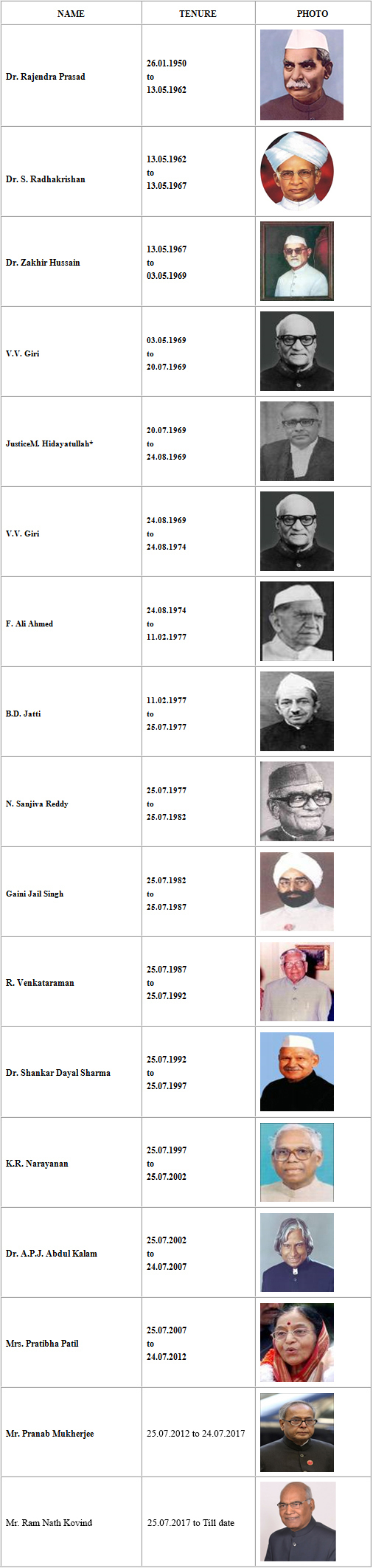
Post a Comment
RJ: If you have any doubt or any query please let me know.